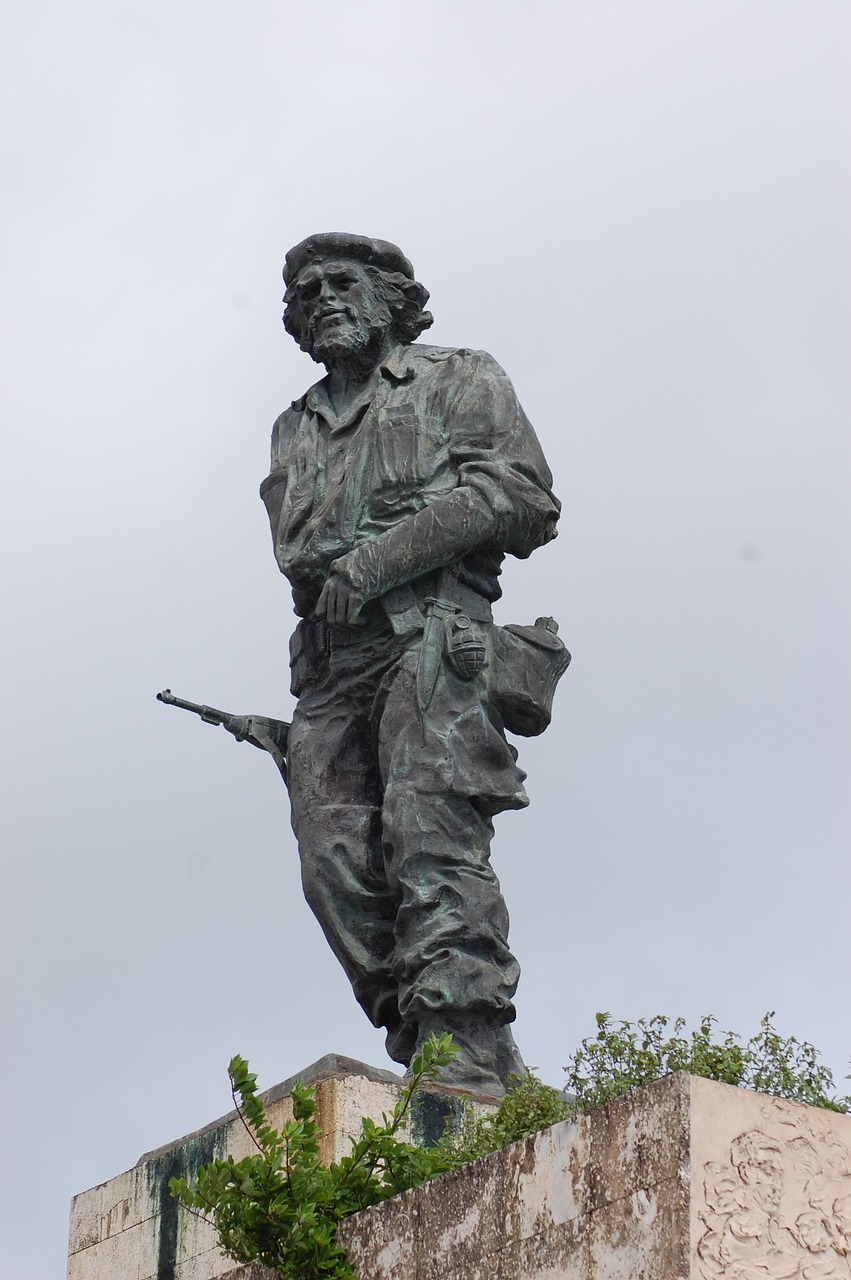
Mausoleum of Che Guevara
The final resting place of the remains of Che and 29 other comrades assassinated in Bolivia in 1967. The entrance to the mausoleum is dominated by the imposing bronze statue of the Comandante, about 7 meters high, with a weapon in his hand. The statue was placed so that it faces south, towards Latin America, as a symbol of Che’s vision of a Pan-American revolution against imperialism. Santa Clara is the birthplace of Che Guevara.
The highlights of Guevara’s life and actions are depicted in relief, and his last letter to Fidel Castro is inscribed in full on a special inscription.The construction of the mausoleum began long before the discovery of Che’s hidden grave in the Bolivian countryside. The construction, for which hundreds of thousands of city residents (in addition to the teams) volunteered their time, began in 1982 and was completed in 1988 when the monument was inaugurated.
Designed by sculptor Jose Delarra and architect Jorge Cao Campos, it was inaugurated on December 28, 1988. The mausoleum’s reputation as a place to welcome visitors from all over the world, however, began in mid-1997, when the remains of Che Guevara, discovered by scientists in Vallegrande, Bolivia, were transferred there. In October 1997, the city of Santa Clara, in the presence of thousands of Cubans and the country’s political leaders, received the wooden coffins containing the remains of Che and six other companions. Among his belongings were a pistol case, his uniform, his watch, his pipe, the flask in which he drank mate tea, his beret, his jacket, his field glasses, his camera, his radio and his telephone that he used during the battles of Santa Clara.
On the same day, Fidel Castro delivered a eulogy in memory of his comrade and comrade-in-arms, sirens sounded in all the cities of the island and 21 cannon shots were fired in Santa Clara and Havana. Fidel Castro lit a flame in the Mausoleum that has never been extinguished since. During the following three years, the remains of 23 guerrillas found in mass graves in Bolivia were buried in the Mausoleum.
History of the death of Che Guevera
Fate led Che Guevara to Bolivia, whose authorities, frightened by his activities, requested the help of American allies and organized a real operation. The special services of almost all the neighboring countries tracked down the revolutionary and his companions. In 1967, the location of the detachment was discovered, it was defeated and the commander was captured. Finally, the Bolivian soldiers were ordered to shoot, and they even had a lot of discussion about who would do it. It is interesting to note that the Bolivian military dictator of the time assured until the end of his life that he had not given such an order.
Bolivian General Mario Vargas Salinas, who witnessed the capture and execution of Ernesto, after decades of silence, revealed in 1997 the site of the secret burial of Che Guevara and his comrades. They were buried under the runway of the Vallegrande airport. Then the Cuban government appealed to the Bolivian government to request that excavations begin at this site. And after a year and a half of research, bodies were found.
Video
C23C+372, Santa Clara, Cuba
https://goo.gl/maps/jr7WGZV4EjgwAZJYA