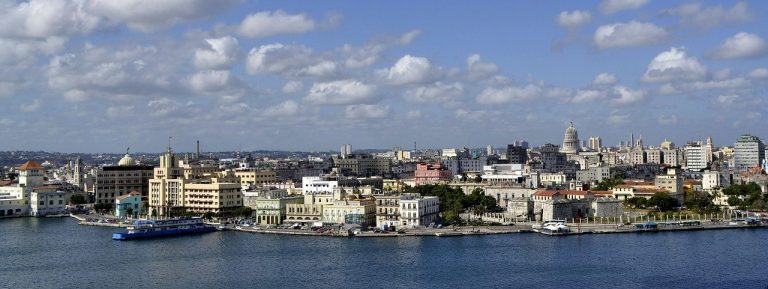
Cuba
Nestled between the Caribbean Sea and the Atlantic Ocean, Cuba is an island with a powerful charm, bathed in light and an incomparable human warmth. Its eventful past and its striking beauty make it a destination apart, almost legendary. When he set foot on its shores in 1492, Christopher Columbus would have declared: “This is the most beautiful land that man has ever seen.”An affirmation that has remained in the memories and that continues to enchant those who discover the island.
The Cuban archipelago is not limited to its large main island: it is also composed of a multitude of cayos and islets with jagged shapes, scattered like so many tropical jewels. The landscape offers a range of striking contrasts: mountains covered with humid forests, fertile valleys in the heart of the country, endless beaches of white sand bordered by turquoise waters, not to mention the red lands planted with tobacco in the Viñales region.
In the cities, the architectural heritage tells the story of the country, between Spanish influences, neoclassical touches, and colorful art deco. Some of them, such as Havana, Trinidad and Cienfuegos, have been elevated to the rank of Cultural Heritage of Humanity by UNESCO, as their authenticity and artistic richness are preserved. Walking along their cobbled streets, the visitor travels through the centuries, carried by the rhythm of salsa that resonates at every street corner.
The Cuban population is the vibrant soul of the country. Known for her sense of hospitality and spontaneous generosity, she proudly cultivates her mixed culture and her taste for celebration. Sharing a meal, a dance, or a moment of daily life with the locals is often one of the most striking memories of a stay in Cuba. The Cuban population is rich in a tasty mix of ethnicities that arrived in the island at different periods of history. Miscegenation is common while the most diverse cultural particularities have grouped together over time to constitute an interesting variegated culture. Cuba has 11 million inhabitants concentrated mainly in the outskirts of Havana, Santiago de Cuba, Holguín, Matanzas and in the provinces of the center of the country
But Cuba is not limited to its folklore, nor to its sunny postcards. It is a territory of contrasts, both preserved and alive, wild and refined, where you can indulge in an infinity of experiences. Dive into coral lagoons, venture into the Sierra Maestra mountains, go big game fishing, cool off under a secret waterfall, explore colonial cities frozen in time… In Cuba, all travel dreams take shape, carried by a generous nature and a deeply human people.
Physical presentation
Cuba, located at the entrance to the Gulf of Mexico, is 170 km from the American coast. This country, with an area of 110,860 km2, stretches in length for 1200 km and its width, depending on the zones, is from 31 to 195 km. Its shape recalls that of a crocodile, an animal that swarms in the region of Guama. Its coasts are bordered by a multitude of attractive beaches while the rest of the territory is divided between cultivated lands, swamps, hills, plains and mountainous areas.
The island has a few rivers and, despite their rarity, these enrich the tourist panorama.
The climate
Cuba has a subtropical climate. There are 2 seasons, a dry season (November to May), a wet season (June to October). Between the two, the temperatures vary little and remain around an average of 25 ° C. The difference lies in the rate of precipitation that falls on the country. Nevertheless, even during the wet season, the weather is fine, the rains taking the form of strong and short showers.
Cyclones
Contrary to the alarmist reactions of Europe and the spectacular images that are broadcast there, cyclones are perceived in Cuba as a natural phenomenon with controllable risks. Indeed, Cuba is implementing all possible logistical means to shelter the local population and foreigners staying in the country. Thus, most of the damage caused there is of a natural nature. Cyclone Katrina revealed the disorganization of the United States in the face of this kind of phenomenon, such a disaster could never happen in Cuba.
No air flight to Cuba has ever been canceled due to a cyclone: the phenomenon is very localized and its evolution is predictable 48 hours in advance, which allows airlines to insure their flights and plan the landing place. Nothing to do with earthquakes and tidal waves, which, on the other hand, are unpredictable.
And anyway, even if you are traveling during the wet season, the probability rate that you will encounter a cyclone in Cuba remains very low.
Time difference
The time zone of Cuba is the meridian 75 West which coincides with that of the winter time of New York in North America and with that of the West in South America. Cuba marks a difference of 6 hours with the countries of Western Europe. The dates of change of hours are, in winter the last WEEKEND of October, in summer the last WEEKEND of April or the first week of May, to be checked… because it can be modified at any time…
Fauna and flora
The Cuban territory is rich in many endemic species. We meet the different animal species present on the island mainly in the mountainous, marshy regions, and on the islets. Reptiles, birds and marine mammals constitute the main of this fauna.
For the flora, more than 6,000 species remain despite the extensive deforestation campaigns that the forests have undergone. Tropical forests still occupy part of the territory.