
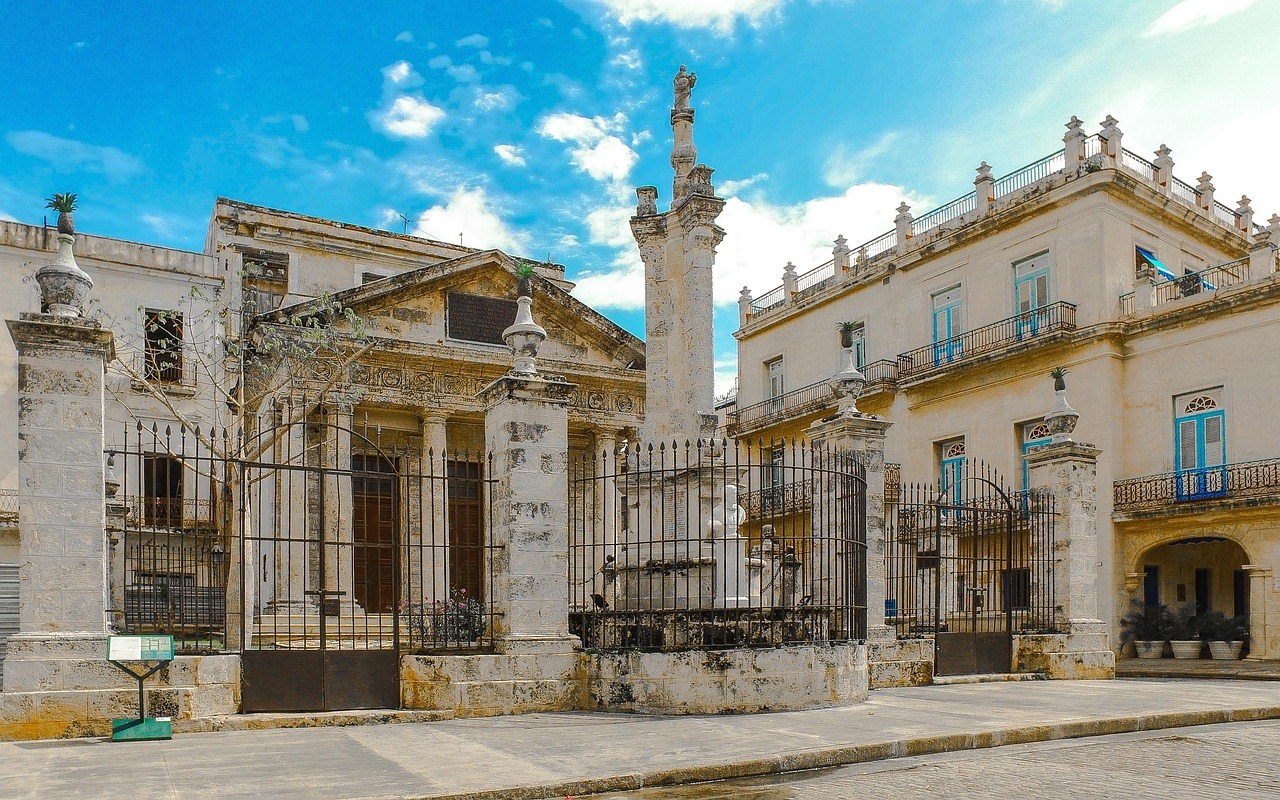
The Temple
Located on the edge of Fraternidad Park, in the heart of Havana, The Temple – or El Templete in Spanish – is one of the most symbolic monuments of Cuban history. Behind its discreet and classic appearance hides a place highly charged with meaning: it marks the site where the very first Catholic Mass was celebrated and the official foundation of the city of Havana in 1519.
A column, a mass, a city
This small neoclassical building, built in 1828, stands on the very spot where the Spanish conquistadors, led by the conquistador Pánfilo de Narváez, would have founded the city under a ceiba tree. It is there, according to tradition, that both a mass and a first municipal council were held. The tree no longer exists today, but a commemorative stone column indicates precisely the place of this inaugural event.
Around the temple, every year on November 16, the Havanese celebrate the anniversary of the city by performing a ritual: they go around the symbolic ceiba three times in silence, touching the column while formulating a wish. It is one of the most respected popular events in the capital, a moment of meditation mixing faith, history and superstition.
A sober but solemn architecture
The building, in neoclassical style, was designed by the engineer Antonio María de la Torre. Inspired by Greco-Roman temples, it consists of Doric columns, a triangular pediment and a sober but refined interior. Although it is modest in size, the effect produced is solemn: everything here reminds that we are on a sacred place for the Cuban national identity.
Inside, there are three large canvases by the French painter Jean-Baptiste Vermay, which illustrate the founding scenes: the mass, the meeting of the cabildo and the planting of the first ceiba. Vermay, who was also the founder of the Academy of Fine Arts of San Alejandro, also rests under a marble slab inside the temple itself, sealing his bond with this unique place forever.
A visit that is both historical and intimate
Unlike the great fortresses or the colonial palaces, El Templete stands out for its almost silent atmosphere, out of the tourist hustle and bustle. It is a space conducive to contemplation, respect for the past and the discovery of another face of Havana: that of its origins, its myths and its spiritual roots.
Access to the site is simple, as it is located in the historic Habana Vieja district, a stone’s throw from the Plaza de Armas. The temple is usually open from Tuesday to Sunday, from 9 a.m. to 16:30 p.m. The entrance ticket costs about 50 euros, and gives access to the interior of the monument as well as the frescoes. Guides are sometimes available outside to explain the symbolism of the place, although the visit can also be done independently.
A fundamental witness of Cuban identity
The Havana Temple is much more than a building: it is a historical and spiritual anchor point for a city that, for more than 500 years, has developed between religion, colonial power and popular culture. To visit it is to go back to the origins of the capital, to feel the trace of a founding moment, and to understand how the past can still vibrate in the most silent stones.


